


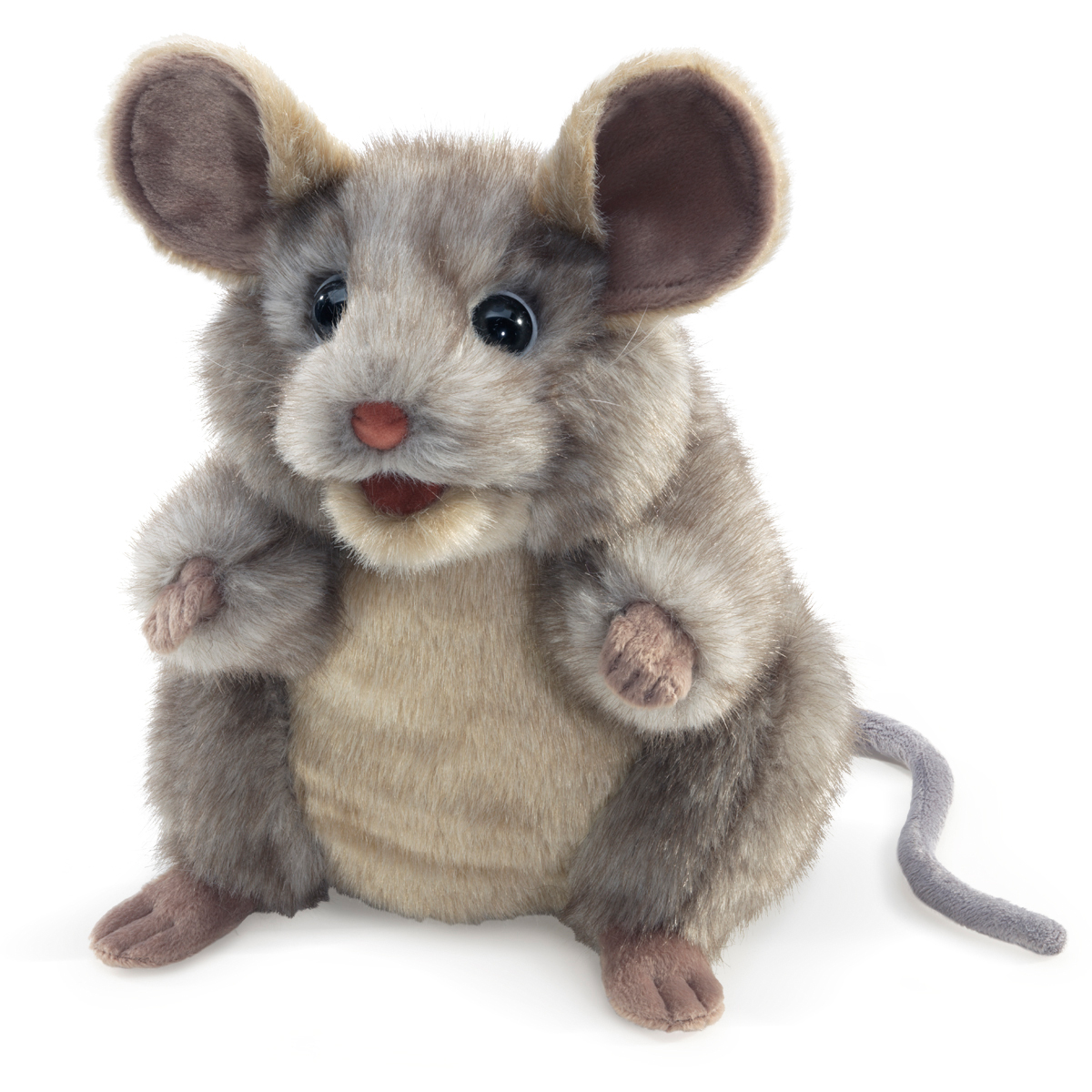


What sets Folkmanis hand puppets apart
Folkmanis has been making hand puppets since 1976, and most of them are modelled on a particular animal or creature. That is why many names go right down to the breed or species: a Holland Lop Rabbit, a Valais Blacknose Sheep, a Komondor, a Pink Fairy Armadillo. New characters join the range twice a year, while older ones are gradually retired.
Choosing a Folkmanis puppet for your story
A character that does the talking
For a story read aloud, a song or a chat with the group, pick one of the many hand puppets with a movable mouth. The Grey Wolf or the Timber Wolf can play the wolf in Little Red Riding Hood, and the Alligator snaps at whoever comes too close. The bespectacled Bookworm is a natural choice for library story time. Some birds talk with a movable beak instead, such as the Crow and the Duck. For a funny hand puppet, try the Funny Frog or the Silly Bird.
A character with paws or arms
Many of the animals have front legs you can work as well as a movable mouth. The Raccoon can rummage with its paws, and the Grey Squirrel holds the acorn it comes with while it chatters. On the Monkey, the Baby Chimpanzee and the Yeti, the arms move as well as the mouth. On a few, such as the Hedgehog, the Chipmunk or the Dutch Rabbit, it is the head and all four legs that move rather than the mouth.
A character with a surprise
Some characters can hide away and pop out again. Among them are the Raccoon in Garbage Can, the Bear in Tree Stump, the Large Rabbit in Hat, the Dinosaur Baby in Egg, the Snail and several turtles. The Armadillo even rolls up and is held closed by magnets. The moment a character pops back out is what peekaboo games and stories about shyness or courage are made of.
Turning heads, flicking tongues and animal noises
On several owls, such as the Great Horned Owl, the Snowy Owl and the Screech Owl, the head turns; the Great Horned Owl can blink as well. The Chameleon and the Iguana flick out their tongues, while the Bald Eagle and the Griffin spread their wings. A squeeze makes the Bleating Sheep bleat, the Grunting Pig grunt and the Hooting Owl hoot.
Glove-shaped and reversible hand puppets
A few Folkmanis designs are shaped like a glove and pulled straight over the hand. The Blue Tarantula walks on all its legs, the Horseshoe Crab moves its front legs, and the Red Octopus moves all eight arms. According to Folkmanis, the Honey Bee and the Red Octopus work equally well on the left or the right hand.
On the reversible hand puppets, zips take you from one stage of a life cycle to the next. The Frog Life Cycle turns from egg to tadpole to frog, which then talks with a movable mouth, and the Monarch Life Cycle goes from caterpillar to chrysalis to butterfly. For a science topic on metamorphosis, one hand puppet covers every stage.
Size and fit
The animal's shape decides how your hand fits inside.
- Compact characters: owls such as the Small Snowy Owl or the Pygmy Owl are barely bigger than the hand that works them.
- Long characters: the Boa Constrictor and the Bookworm cover the whole forearm, and their bodies hang well beyond it.
- Not sure about the fit? How much room there is inside a character is hard to judge from a photo, so ask us before you order.
Where Folkmanis puppets are used
In nurseries and early years settings, a woodland or farm animal hand puppet can introduce the topic of the week. Primary teachers use the realistic animals for lessons on habitats, food chains and life cycles. Speech and language therapists and occupational therapists work with them in one-to-one sessions. In elderly care and dementia care, staff reach for familiar animal hand puppets, such as a dog, a cat or a bird. At home, Folkmanis plush hand puppets join in at bedtime and are often given as birthday presents.